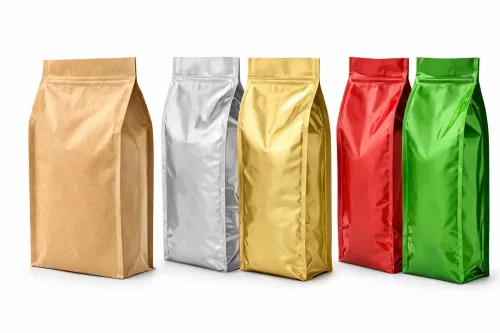
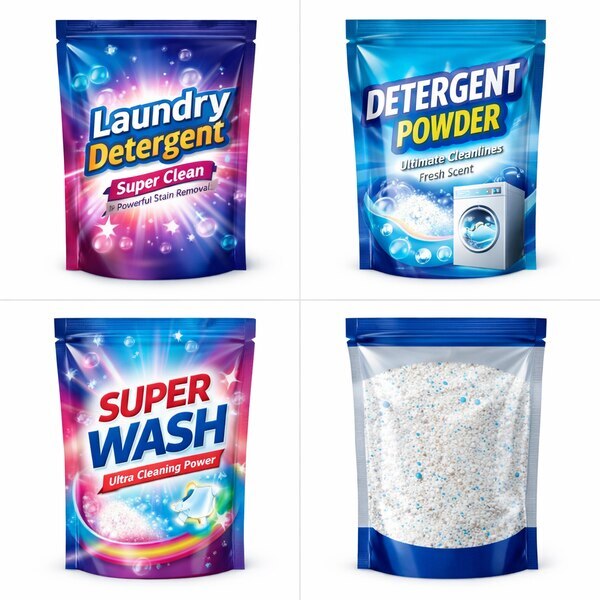
Fine detergent powder exposes weak points that ordinary pouch specifications miss: contamination in the seal, humidity entering through closures, trapped air, abrasion, and poor stacking. By the end, you will be able to connect pouch construction, laminate selection, filling settings, dimensions, and supplier test data to fewer leaks, burst packs, caking incidents, and line stoppages.
Key takeaways
- Keep powder out of the seal area before applying heat and pressure.
- Specify moisture resistance with film structure, seal strength, and storage conditions.
- Match pouch width, gusset, and fill weight to stacking and consumer handling.
- Request seal, barrier, leak, and dimensional test results before approval.
How the center seal contains detergent powder from filling to shelf handling
A center seal contains detergent powder by closing the pack along its back before the product reaches transport or shelf handling.
In detergent powder center seal pouches, rollstock travels over a forming collar and wraps around a forming mandrel; its longitudinal edges meet at the rear and heat-seal, while transverse jaws create the top and bottom seals.
The continuous form-fill-seal route forms, fills, and closes each pouch from one web, removing separate pouch-opening and pouch-loading operations. It only works reliably when you:
1. Keep the web centered with accurate tracking and set the forming collar so the edges meet evenly. Confirm sealant-to-sealant orientation; unstable friction, curl, poor registration, or reversed layers can create tracking defects.
2. Synchronize the transverse jaws with the web movement so each top and bottom seal lands in the intended position. A wider, clean sealing land gives powder fewer paths through the closure, but excessive width consumes film and reduces usable pack volume.
3. Keep powder away from every sealing surface and allow the fill to settle before closure. Clean jaws, controlled filling, adequate headspace, and air removal reduce channels, weak spots, pinholes, and burst packs.
The center seam is not the moisture barrier by itself. The laminate, sealant layer, longitudinal seal, and two end seals must work together to resist humidity, abrasion, stacking pressure, and repeated retail handling; a sound seam cannot rescue an unsuitable laminate or a microleak.
How to fill and seal without trapping powder in the closure
Let the powder settle before closing the pouch. Meter the target dose, pause long enough for the powder to drop below the seal land, control fill height and headspace, then remove trapped air through gentle settling or controlled compression—not by squeezing product into the closure.
- Keep the forming shoulder, guides, sealing jaws, and sealable film land free of powder. Use dust extraction or controlled powder flow where the line design permits.
- Set jaw temperature, pressure, and dwell time through trials. Do not copy one temperature from a film datasheet; line speed, film thickness, contamination, and jaw temperature change the usable setting.
- Use ASTM F2029 heat-sealing curves to identify the sealing window for the actual laminate and machine.
- Stop and correct dusty filling, wrinkles, narrow seal width, burn-through, incomplete seals, pinholes, and intermittent leaks before releasing detergent powder packaging pouches.
Seal strength and leak-tightness need separate checks:
| Test | What it measures | What it cannot prove |
|---|---|---|
| ASTM F88/F88M | Force needed to separate the seal | That every filled pouch is leak-free |
| ASTM D3078 | Gross leaks in flexible packages with a nonporous barrier | Seal separation strength |
| Filled-pouch trials | Drop, compression, and handling performance | A universal result for another fill weight or line |
Run filled-pouch drop and compression tests after production. Film-only results miss powder movement, impact, and stack loading that cause burst packs.
How to specify moisture resistance for detergent powder
Specify moisture resistance as a measurable laminate performance, not as the phrase “moisture resistant detergent packaging.” The structure should name every layer and thickness: print layer, outer support film, aluminium foil or metallized film, adhesive, and heat-sealable inner layer.
Also record puncture and impact resistance, stiffness, and sealant compatibility with alkaline detergent, enzymes, builders, dyes, and fragrance oils.
Request WVTR in g/m²/day with temperature, relative humidity, film thickness, and test direction stated. ASTM F1249 measures water-vapour transmission through plastic film and sheeting; a result without those conditions cannot support a shelf-life decision.
Check moisture entry through the film, seal edges, pinholes, poor closures, and repeated opening when the pouch is not designed to be reclosable.
| Structure | Advantage | Main risk |
|---|---|---|
| Aluminium-foil laminate | Stronger moisture and oxygen protection | Creasing or pinholes can destroy the barrier |
| Metallized-polymer laminate | Better flex performance and potentially lower material use | Barrier depends on coating quality, abrasion resistance, and converting quality |
Test production pouches after lamination curing, slitting, roll storage, and filling. Unconverted-film data cannot prove filled-pouch performance. Include ASTM D1709 impact testing where relevant, puncture and drop tests, compression testing, stiffness checks, and seal inspection; a thinner gauge saves material only if it survives handling without leaks or burst packs.
How pouch dimensions and format affect handling, stacking, and consumer use
Match pouch dimensions to detergent weight, machine limits, and distribution stress—not to film savings alone. A narrower pouch can reduce film per kilogram, but a small seal land, poor powder settling, high fill-weight variation, or excessive product movement raises leak risk. Set pouch height, web width, seal width, headspace, gusset depth, and fill-to-pouch-volume ratio together.
Confirm the design on the existing form-fill-seal machine before approval. Check:
- Web-width tolerance, curl, coefficient of friction, splice limits, forming-collar fit, and sealing-jaw clearance.
- Stacking pattern, pallet compression, drop exposure, corner impact, and abrasion.
- Whether cartons, shrink bundles, or woven outer bags can protect the primary pouch instead of requiring a heavier laminate.
Format choice changes both handling and consumer use.
| Format | Strength | Choose it when |
|---|---|---|
| Center-seal pouch | Continuous roll-fed production and compact transport | Standard retail and moderate weights |
| Three-side-seal pouch | Stable flat shape and simple pre-made-bag filling | Short runs or special dimensions |
| Zipper pouch | Repeated dispensing and reclosure | Consumers reopen the pack frequently |
| Paper bag | Familiar handling but weaker moisture and puncture protection | Dry, lower-risk routes with an outer pack |
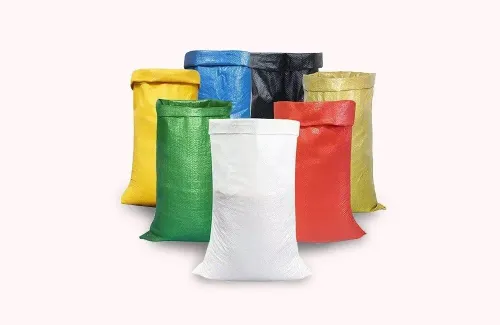
| Woven sack | High load capacity and abrasion resistance | Large bulk weights |
| Rigid tub | Strong stacking and shelf presentation | Rigid support matters |
| Spout pouch | Controlled pouring | Liquid or flowable products, not ordinary powder |
Choose another format for sharp granules, very large weights, repeated reclosure, or rigid stacking requirements. A center seal is efficient, not universal.
What to request from a washing powder pouch manufacturer before approval
Approve a washing powder pouch manufacturer only when its claims arrive as test records and production samples, not a catalogue description. “Center seal detergent pouches in ahmedabad” is a location search phrase, not evidence of technical capability.
Request these items:
- Complete laminate construction, each layer’s thickness, sealant type, and chemical-contact declaration where applicable.
- WVTR test method, temperature, relative humidity, film thickness, direction, and result; ask for ASTM F1249 data when used.
- Seal-strength results, filled-pouch leak rate, drop and compression results, and ASTM D1709 impact data where relevant.
- Coefficient-of-friction values, web-width tolerance, curl limits, splice policy, and the usable sealing-temperature window.
- Retained pouches from an actual production run, with batch identification.
| Evidence | What to verify | Failure it exposes |
|---|---|---|
| Heat-seal curve | ASTM F2029 data across temperature and line speed | A single “recommended” temperature |
| Line trial | Detergent-filled pouches sealed on your intended machine | Powder contamination, tracking, or weak seals |
| Aged roll trial | Samples after curing, slitting, roll storage, and sealing | Converting damage or barrier loss |
| Transport test | Leak rate, appearance, fill weight, caking, drop, and compression together | Burst packs that film-only tests miss |
Amples Laminates LLP becomes worth comparing when it links production to these specifications, runs a controlled trial, and states the structure’s limits. Approve only after reviewing all results together.
Related products
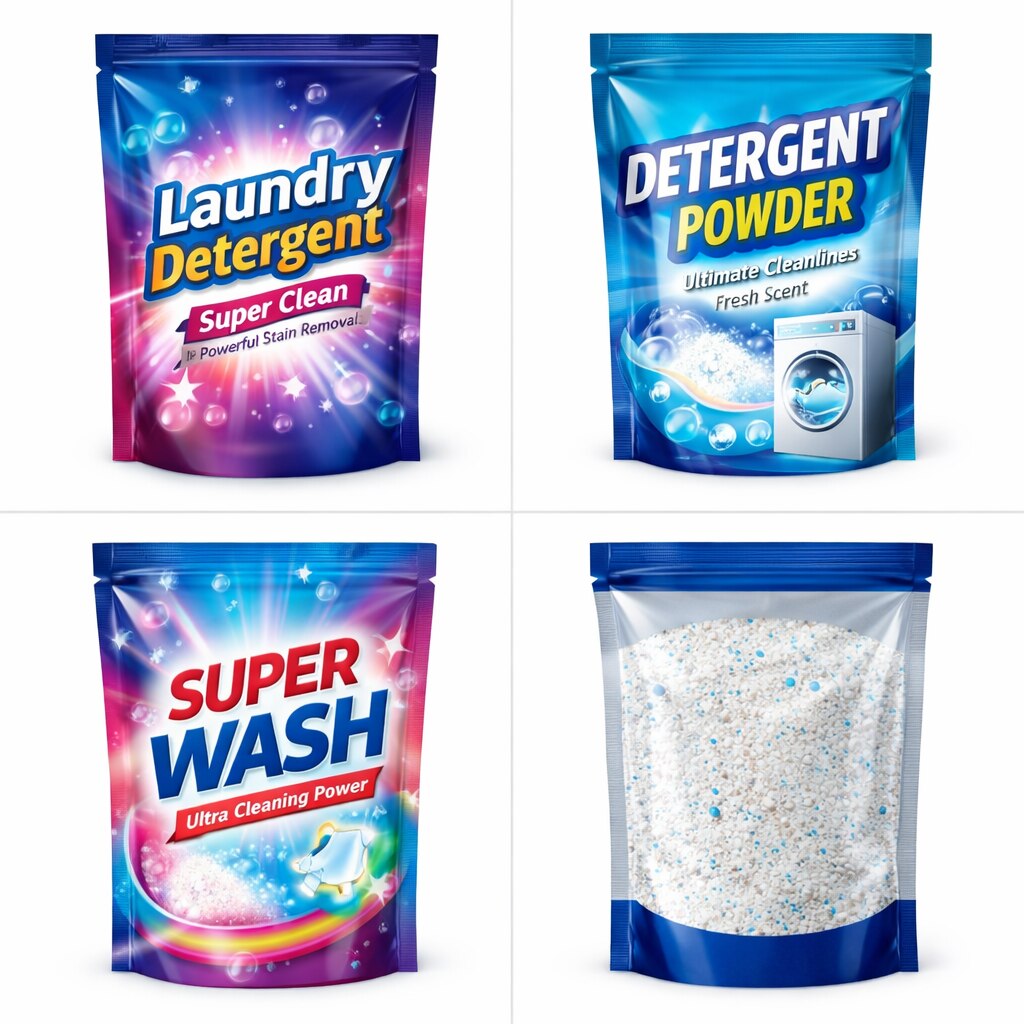 | Center Seal Pouches Detergent Powder Center Seal Pouches Manufacturers We are also supply in Andhra Pradesh, Arunachal Pradesh, Assam, Bihar, Chhattisgarh, Goa, Gujarat, Haryana, Himachal Pradesh,... View product → |
 | Center Seal Pouches Powder Product Center Seal Pouches Manufacturers We are also supply in Andhra Pradesh, Arunachal Pradesh, Assam, Bihar, Chhattisgarh, Goa, Gujarat, Haryana, Himachal Pradesh,... View product → |
Frequently asked questions
How do center seal pouches contain detergent powder during handling?
They close the film along the back of the pack, creating a continuous longitudinal seal that contains powder during filling, transport, shelf handling, and opening.
How do you prevent detergent powder from becoming trapped in the pouch seal?
Control the filling speed, keep powder below the seal zone, remove residue before sealing, and validate sealing temperature, pressure, and dwell time on production samples.
What moisture resistance should detergent powder packaging have?
Specify a film structure with a documented moisture barrier, compatible heat-seal layer, seal-strength target, and test results for the intended storage and transport conditions.
How do pouch dimensions affect washing powder handling?
Pouch width, height, gusset, and fill volume determine stability, stacking efficiency, grip, dispensing control, and the space required for the back seal.
What should you request from a washing powder pouch manufacturer before approval?
Request the film structure, thickness, seal-strength data, moisture-barrier results, dimensional tolerances, print details, filling guidance, and samples tested with your detergent powder.
Keywords